- 75% of Factory PRs merge
- 91% need no engineer commits
- 97% less time to fix
- 70% of auto-detected fixes
- 81% of log-triage fixes
Built for the work that keeps piling up
Software Factory is designed to work autonomously on bounded, verifiable engineering tasks like:
- Production bug fixes
- Flaky test resolution
- Code health and cleanup
- Log hygiene
- Small features and fixes
- Routine maintenance
- Conflict resolution
The work that is important enough to do, but rarely important enough to interrupt your best engineers.

From issue to review-ready PR
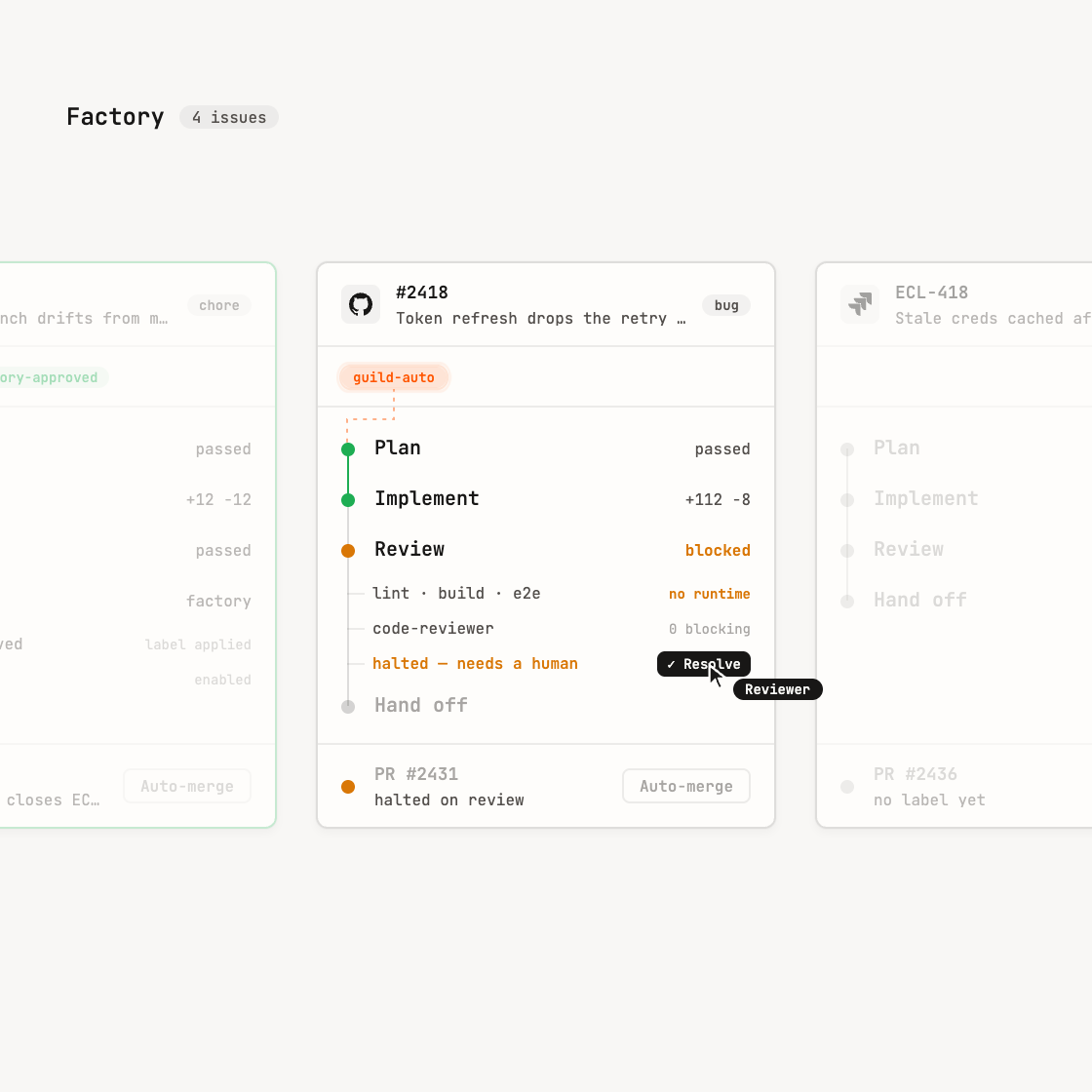
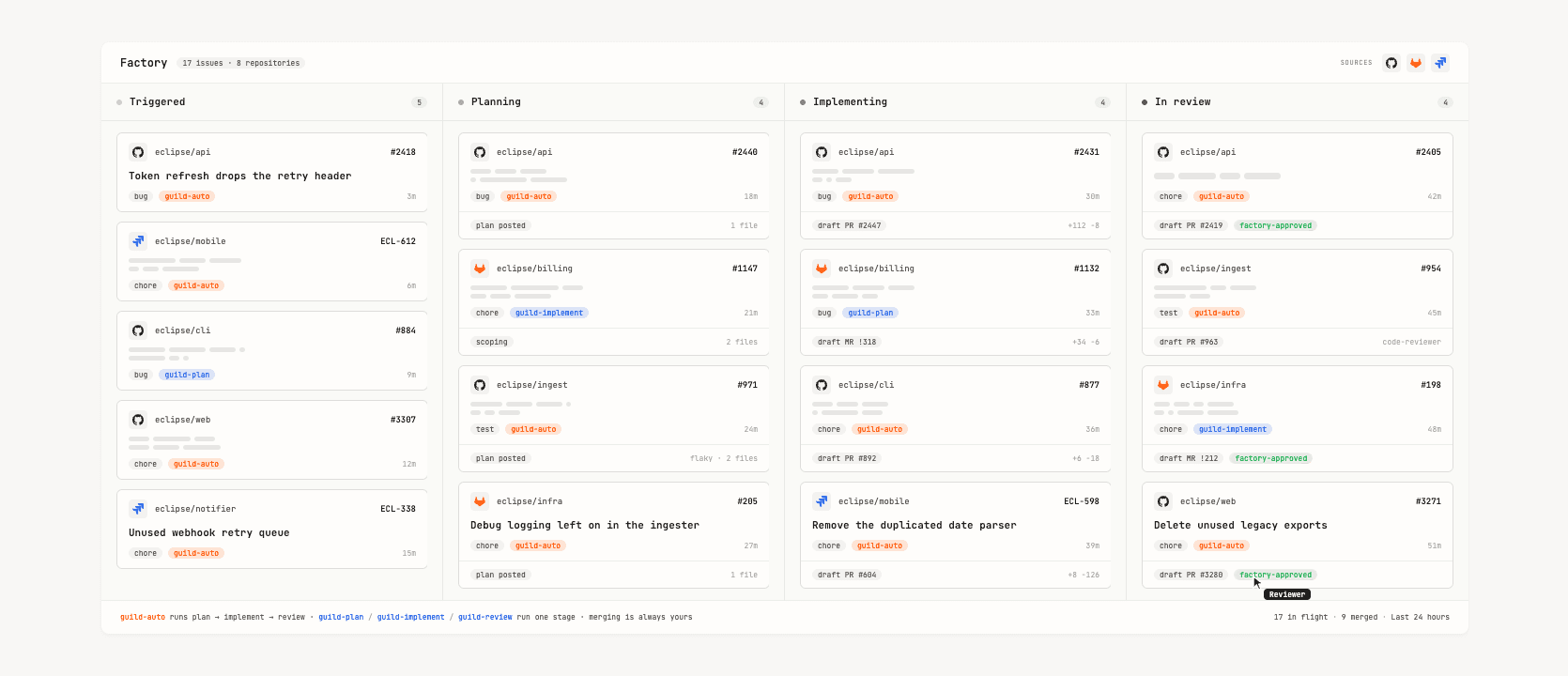
Add the guild-auto label to a well-scoped GitHub, GitLab, or Jira issue, and Software Factory gets to work.
- PlanA planning agent reads the issue, gathers context, and defines the approach.
- ImplementAn implementation agent autonomously writes the code in a sandboxed environment and runs your existing checks.
- ReviewA separate review agent checks for meaningful problems, incomplete work, and scope drift.
- Hand offOnce the change is ready, the pull request is handed to a human for final review and merge.
Your best engineers shouldn’t be babysitting small changes
Here’s what that looks like at Guild. Every figure below is measured on our own production codebase.
75%
of Factory pull requests are accepted and merged
91%
merge with no engineer commits on top
97%
less time to fix. What took a month takes a day
70%
of fixes for auto-detected issues come from the Factory
81%
of log-triage fixes are written by the Factory
25%
of alerts have a fix PR up within 90 minutes of firing
56%
of all code fixes at Guild now come from the Factory
80%
of code changes to the Guild CLI are written by the Factory
Not another coding agent.An engineering system.
Software Factory is not one giant autonomous developer. It is a system of specialized agents with narrow responsibilities, running on top of Guild. The coding agent is only one part of the system, and the agents below keep the Factory itself running.
- Conflict Resolver
The guild-sync agent merges the current main branch into Factory branches and treats main as the source of truth, resolving routine conflicts without an engineer taking ownership of the branch.
- Janitor
Checks for stale or stuck jobs every few hours and can retry a stalled workflow or start a sync. If attempts do not make progress, it stops and escalates to a person instead of running indefinitely.
- Code Health
Looks for recurring problems — duplicated helpers, dead code, and patterns automated coding systems commonly introduce. It does not silently make changes; it files an issue.
- Test Triage Agent
Responds to CI failures on main and works out whether a failure is a flaky test, a genuine regression, or an infrastructure problem, then files a scoped issue the Factory can pick up.
Autonomy with clear boundaries
Human approval
- Agents can prepare pull requests, but humans approve and merge.
Bounded execution
- Loop limits and retry controls stop unproductive agent cycles.
Sandboxed and traceable
- Agents run in isolated environments with governed repository access and recorded workflow history.

Built for your codebase
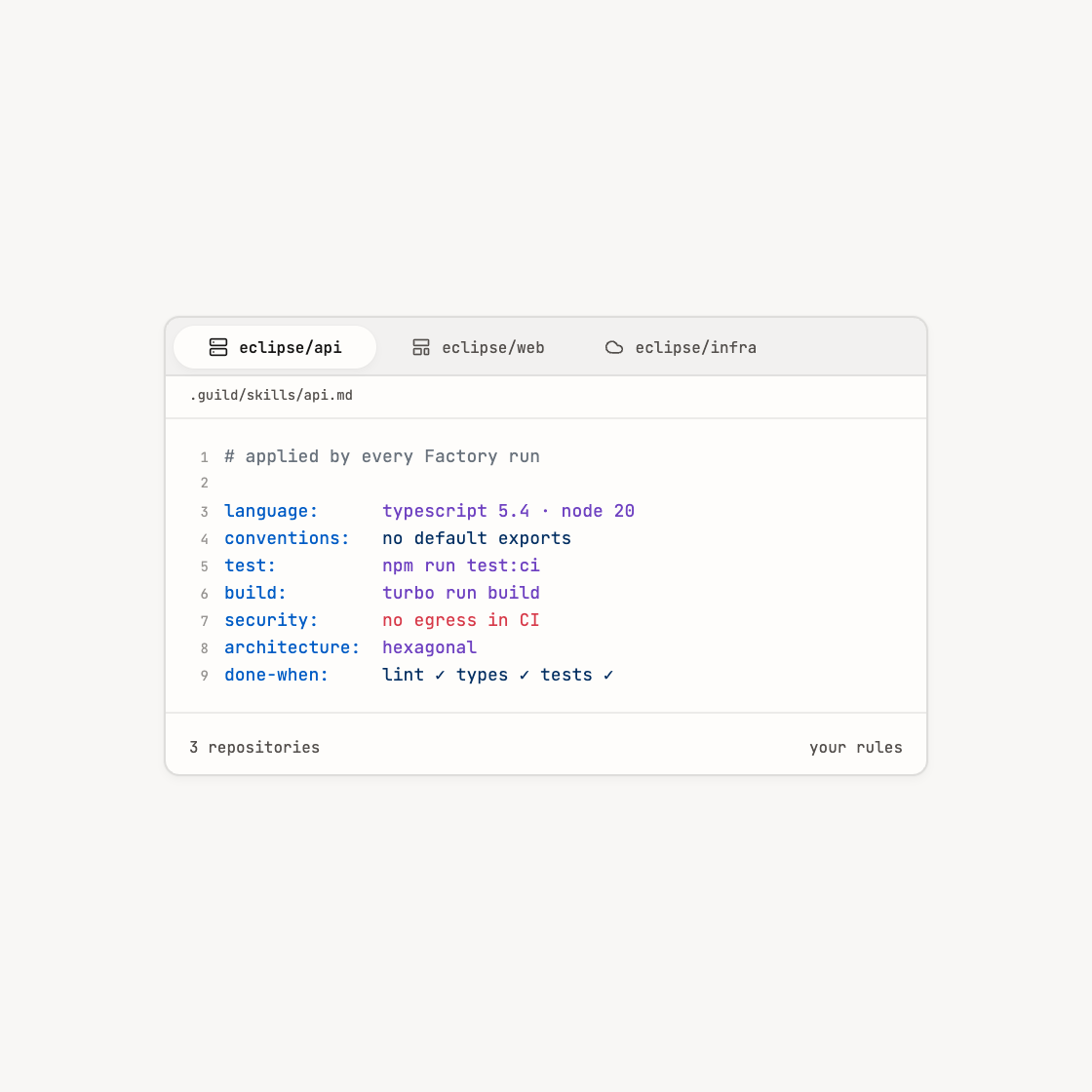
Your repositories have their own standards. Software Factory can adapt to:
- Languages and frameworks
- Coding conventions
- Test commands
- Build requirements
- Security policies
- Architecture patterns
- Definition-of-done criteria
The Factory provides the workflow. Your team controls the rules.

The Factory your team needs.
Software Factory is a proven pattern built on Guild, not a rigid one-size-fits-all product. Use it as it exists. Adapt it to your environment. Or build a completely different workflow on the same platform. Extend it with agents from Agent Hub as your needs grow.
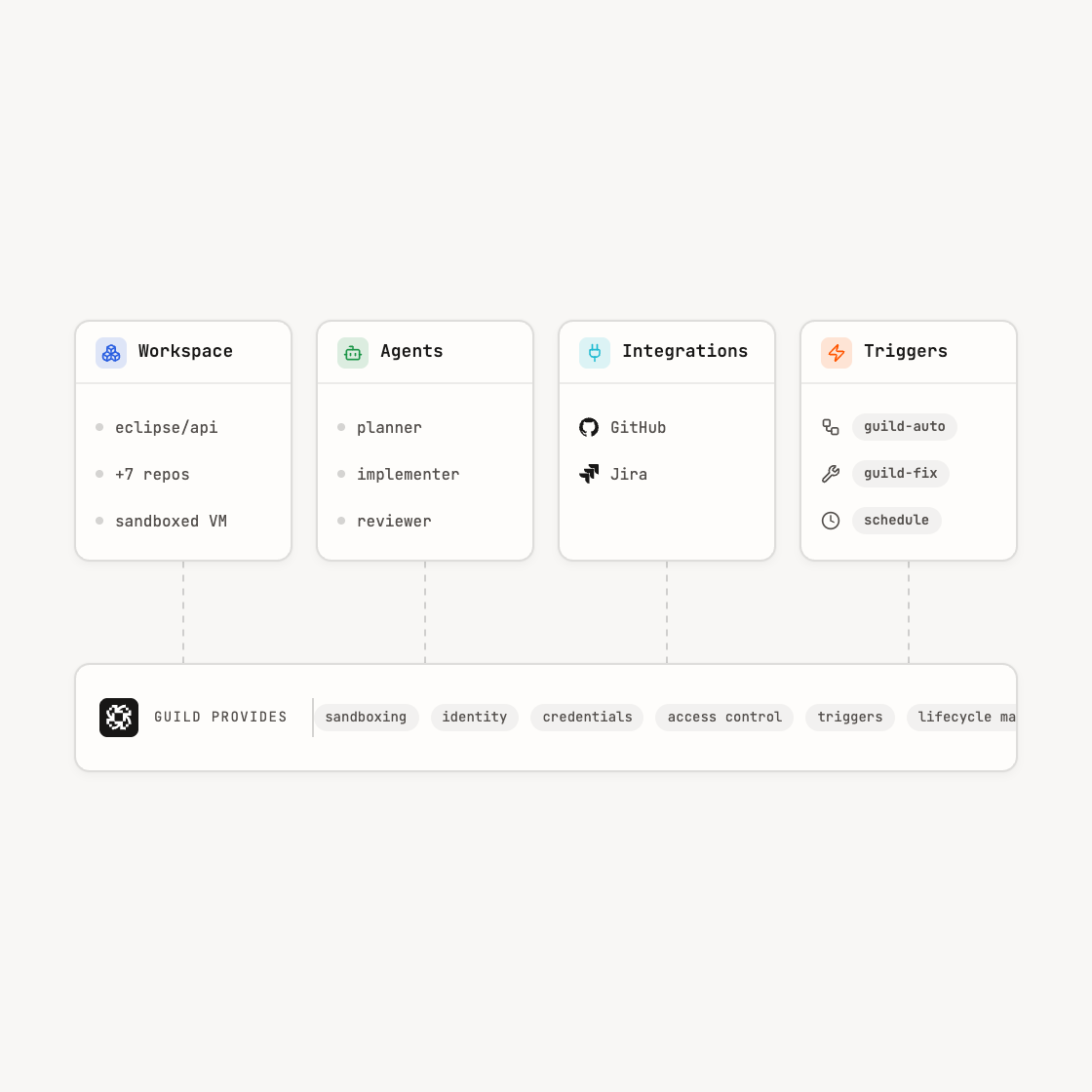
You build the workflow and you own it. Guild provides the infrastructure underneath: sandboxing, identity, credentials, access control, triggers, lifecycle management, observability, cost controls, auditability, and governance.
No. It is designed to handle small, well-scoped work and prepare changes for human review. Engineers retain responsibility for approval and merge decisions.
No. It creates, tests, and reviews draft pull requests, but a person makes the final merge decision.
Production bug fixes, log cleanup, code-health improvements, small features, test triage, and other work with clear scope and acceptance criteria.
Large, ambiguous, or strategically important work that requires extensive product judgment, unresolved architecture decisions, or substantial cross-team coordination.
Guild’s current Factory implementation uses Claude Code in its implementation environment. Guild itself is model-agnostic, so workflows can be adapted to use the models and tools appropriate for the organization.
The implementation agent runs in a sandboxed virtual machine. Guild mediates repository access, and the environment is isolated after setup.
General Factory behavior is separated from repository-specific skills and instructions. Each team can define its own languages, commands, conventions, tests, and standards.
Yes. GitHub labels can invoke the full pipeline or individual planning, implementation, and review stages.
Loop counters, retry limits, and the Janitor prevent workflows from running indefinitely. Work that does not make progress is stopped and escalated to a person.
Factory agents run on Guild, so their model usage and spend are reported alongside the work they produce. Cost per merged pull request is measured, not estimated. New accounts start with 100 million tokens free — 50 million at signup, and 50 million more once the Factory flow is complete. Existing accounts get 50 million through the Factory flow.
No. The Factory is one workflow built on Guild. Guild is the control plane used to build, deploy, connect, monitor, and manage the agents and triggers that make the workflow possible.