2026 ResearchMorning Consult362 U.S. IT decision-makers

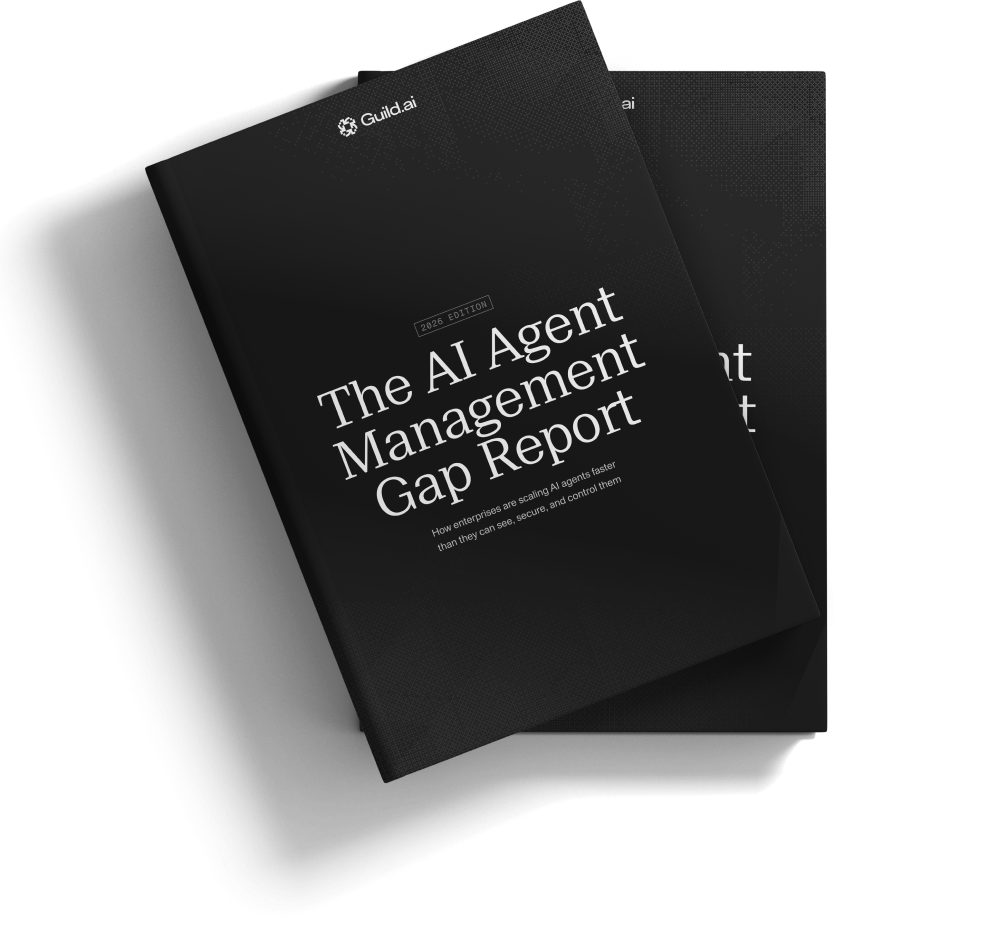
The AI Agent
Management Gap Report

How enterprises are scaling AI agents faster than they can see, secure, and control them

Your team is shipping with AI.
Can your organization keep up with it?

AI agent adoption is no longer the question. Enterprises are already deploying agents across engineering, sales, support, marketing, and other functions, and fleets are growing quickly. Most are already seeing real value from it.

The challenge is keeping visibility, ownership, security, and cost control in step with that growth. Organizations feel confident they know what agents they have and how they’re being managed. The underlying infrastructure tells a different story.

What the research found

  • Policy is ahead of practice. 96% of enterprises run agents in production. No function owns them. Only four in ten log what those agents actually do.

  • Security is the central risk. Nearly everyone feels confident in their oversight. Two out of three have had an incident anyway.

  • Closing the gap drives growth. Real-time visibility is what enterprises want most. Eight in ten plan to spend more to get it.

The AI Agent Management Gap Report

Four enterprise AI agent gaps
Read more inside the report

Visibility

Confidence outpaces control

Almost every organization believes its agent inventory is complete. Far fewer have the infrastructure to prove it.

01

0.0%

of organizations feel confident their agent inventory is complete — but only 42.7% have a centralized dashboard to back that up.

Ownership

No function owns a majority of the fleet

Agents span engineering, sales, support, and marketing, but ownership remains fragmented.

02

0.0%

is the largest share any single function — engineering/IT — claims as primary owner. No function claims a majority.

Detection

Shadow AI is the new shadow IT

Most leaders suspect employees are already deploying agents without formal approval. But suspicion isn't detection. Without registration and centralized visibility, organizations can't reliably know what's running inside their environment.

03

0.0%

say employees are likely deploying agents without formal approval — but only 36% require agent registration before deployment.

Sprawl

Agent sprawl has a hidden cost

As organizations add more agents, teams increasingly duplicate work that already exists elsewhere. Without a way to discover and reuse existing agents, agent growth creates duplicated engineering effort & unnecessary cost.

04

0.0%

of engineering and IT teams lose time to duplicative agent work.

Confidence is high.
Control is harder.

Security is the clearest example of the gap between perception and reality. It is both the top operational concern and a major source of resistance to broader agent adoption.

Organizations feel remarkably prepared to manage their agents.

0.0%

feel prepared to own a long-term agent strategy.

But that confidence doesn't always translate into control.

0.0%

have experienced an agent incident in the last 12 months.

What enterprises need next:

The research points to a clear set of priorities for the next phase of agent adoption.

  1. 01

    Real-time visibility

    Know what agents are running, what they're doing, and how they're performing in production.

  2. 02

    Agent registration

    Know what is being deployed before it enters the environment, rather than discovering agents after the fact.

  3. 03

    Permissions and controls

    Define what agents can access and what actions they can take.

  4. 04

    Cost controls

    Understand where agent spend is going and prevent unnecessary duplication and runaway usage.

Get the full report

Five chapters covering how enterprises are deploying, managing, securing, and preparing for an increasingly autonomous agent fleet.

  1. 01

    AI Agent Adoption and Landscape

    Scale and maturity of adoption, including agent counts, deployment models, ownership, staffing, and use cases.

  2. 02

    Visibility, Oversight and Governance

    Inventory confidence, formal controls, kill-switch readiness, and the incidents that undercut self-reported confidence.

  3. 03

    Unauthorized Agent Activity

    How likely and how concerning shadow AI is, and why detection still lags well behind suspicion.

  4. 04

    Organizational Readiness and Adoption Challenges

    The biggest management gaps, employee resistance, and the real cost of duplicated agent work.

  5. 05

    Future Needs and Priorities

    What organizations want next: centralized visibility, permissions, audit logs, cost controls, and model-neutral infrastructure.

The agent fleet is here.
Now enterprises need to manage it.
AI agents are moving from experiments to production at scale. The next challenge isn't proving what agents can do. It's building the visibility, governance, security, and control to run them responsibly, turning that control into a real advantage.
Book a demo